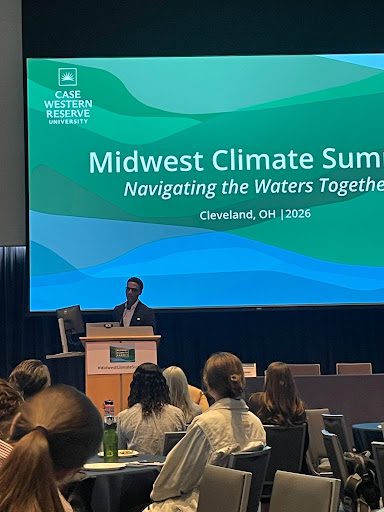
ICLEI – Local Governments for Sustainability USA (ICLEI USA) connected with municipalities, regional entities, and community-based organizations across the Midwest at the sixth annual Midwest Climate Summit in Cleveland, Ohio. Over f three days, ICLEI USA Program Officers, Dan Dickerman and Madison Hodges, met with ICLEI USA members, learned about Cleveland’s robust sustainability programs, and gleaned best practices from U.S. local governments.
Here are the key takeaways shaping local climate action in the Midwest.

Restoring Vacant Land
The summit included mobile workshops that brought participants into Cleveland’s neighborhoods and natural areas. Attendees visited sites along the Cuyahoga River, a location that helped spur the federal Clean Water Act after the river caught fire multiple times in 1969.
A tour with the Western Reserve Land Conservancy showed how Cleveland is transforming vacant lots to City parks, community gardens, and residential properties under the Conservancy’s Thriving Communities program. With the City’s population at about 40 percent of its historic peak, repurposing empty lots has become a core strategy to improve environmental health, foster climate resilience, and equitably build safer neighborhoods.
Participants explored several projects:
- Brighton Park, a former construction-waste landfill, now serves as a 25-acre park with trails, trees, and Cuyahoga River views following brownfield remediation, erosion control, and invasive plant removal.
- Ubuntu Gathering Space, a small park with green stormwater infrastructure and newly planted trees named after the Nguni Bantu term meaning “humanity,”
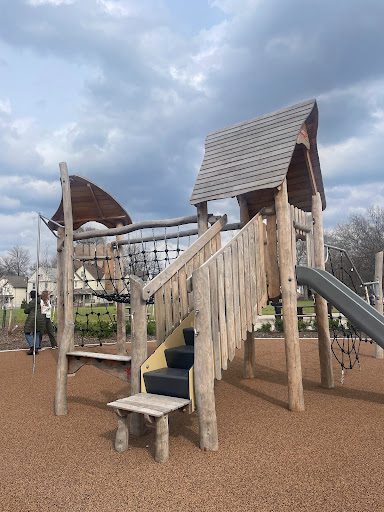
- Thurgood Marshall Green, a space built with natural play material
The tour’s most remarkable highlights included community members who volunteer alongside their neighbors to care for nearby vacant lots and, in turn, care for each other by maintaining community gardens and lawns.
How Projects Get Funded
With federal funding (mostly) in the rearview mirror, U.S. local governments are turning to private capital to advance sustainability and resilience projects.
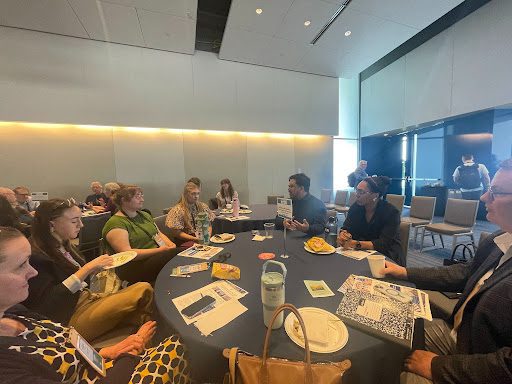
ICLEI USA staff led a Climate Cafe session over lunch, inspired by ICLEI USA’s Municipal Investment Fund, to talk about how municipalities can become financeable and investment-ready. This discussion connected local governments, universities, and consultants from Indiana and Ohio with CEG Solutions, a developer and financier focused on microgrids, energy efficiency, and water infrastructure. Throughout this conversation, CEG Solutions explained why tax credits lead organizations like theirs to seek collaboration with public institutions, and how developers prefer to work on projects over $15 million, encouraging public institutions to aggregate several projects into a single portfolio.
The group also discussed how policies and programs can build the market for sustainable technologies. In Indiana, for example, the heat pump market has lagged behind nearby states. To address this, West Lafayette and Lafayette partnered with Indiana University to:
- Train contractors
- Install a demonstration heat pump at a nonprofit site
- Show building owners how the technology works
This approach helps build both workforce capacity and local demand.
Energy Resilience in the Midwest
Energy resilience came up in nearly every conversation. Midwestern communities are experiencing more frequent and more severe extreme storms, leading to power outages. Recent examples include:
- A recent severe storm destroyed a 700 MW solar farm in Wheatfield, IN, taking out key components of Northern Indiana Public Service Company’s (NIPSCO) renewable energy portfolio.
- A few states away, over 100,000 St. Louis residents faced power outages from
- An EF-3 tornado, which is a rating on the Enhanced Fujita scale, caused many residents in St. Louis to lose power in May 2025
In response, the Great Plains Institute and Climate Mayors led a session focused on energy grid resilience. One workshop asked participants to design strategies for a fictional city preparing for a winter storm by strategically selecting transmission and microgrid resilience measures.
Through the discussion, it became clear that communities need both microgrids, which are local energy systems that can operate independently, and stronger transmission infrastructure to reduce outages and maintain service during extreme weather.
What Makes Projects Worth It
Funding and economic feasibility were central topics of conversation throughout the entire conference.
Speakers highlighted several approaches that are helping communities move projects forward:
- Green Banks, which are public or nonprofit financing institutions, can support energy upgrades in low- to moderate-income housing
- Resilience projects often deliver strong returns by reducing long-term risk
- Geothermal systems become more cost-effective when installed at a larger scale
Overall, climate projects move forward when they align financial value with community benefits.
What We Heard Across the Summit
The Midwest Climate Summit highlighted how communities are moving from pen-and-paper planning to shovel-ready projects. Midwest cities are transforming land, building markets, strengthening infrastructure, and finding ways to fund the work.
Each place is taking a different approach based on local priorities and capacity, which drives progress across the region.