The City of Boynton Beach partnered with ICLEI USA, Community Greening, American Forests, and EcoAdapt to develop the City’s first Urban Heat Resilience Strategy.
As the deadliest weather-related hazard in the U.S., extreme heat is increasingly being recognized as one of the most urgent challenges at the nexus of climate and public health. Florida is no exception: a recent study found that about 1 in 4 Floridians are highly vulnerable to the health impacts of extreme heat. Heavily developed areas like Boynton Beach are especially susceptible to extreme heat because buildings, roads, and concrete trap and hold onto heat, making it feel hotter. This phenomenon is known as the urban heat island effect.
Recognizing that heat resilience is essential to public safety and well-being, the City of Boynton Beach partnered with ICLEI USA, Community Greening, American Forests, and EcoAdapt to create Resilient by Design: An Urban Heat Strategy for Boynton Beach. The Strategy, which aims to mitigate urban heat islands and protect at-risk residents, is the City’s first city-wide heat resilience initiative. The project was supported by a grant from the Climate Smart Communities Initiative (CSCI).
ICLEI USA worked with the City to coordinate the Resilient by Design planning effort; our team also developed a community engagement “meeting in a box” toolkit used at public workshops and citywide events. Community engagement activities included a heat solution gallery walk, participatory mapping exercises, and visioning activities to capture residents’ lived experiences with extreme heat and identify their preferred cooling solutions.
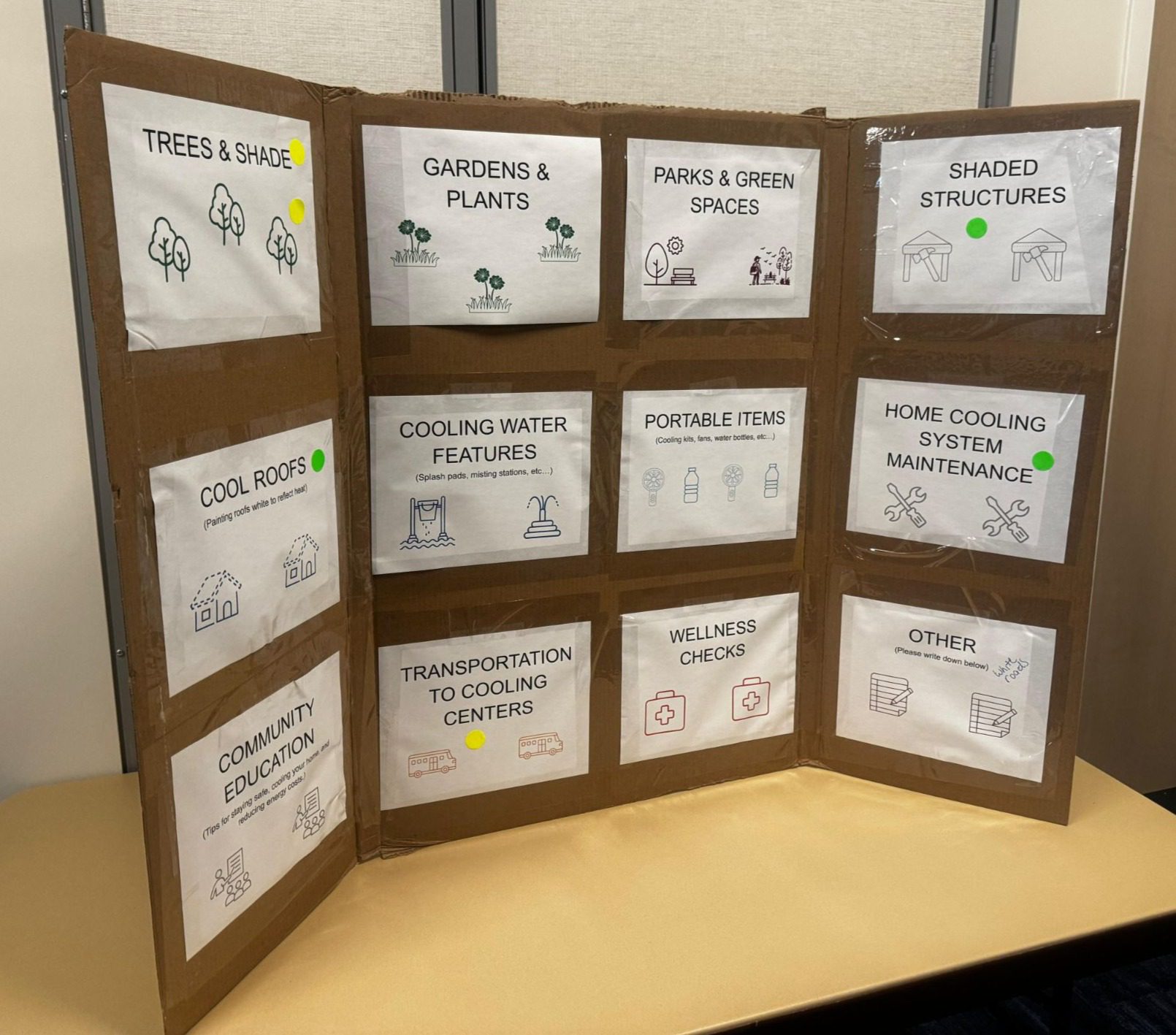
In-person workshops included a heat solutions gallery walk that allowed participants to vote for their favorite cooling solutions.


To help the City identify where cooling solutions should be implemented, residents engaged in a participatory mapping activity using stickers to indicate where in the City they feel the most hot or cool (left). The City of Boynton Beach Sustainability and Resiliency Division engaged with residents during the City’s Earth Month Event (right).
To build internal momentum and alignment, ICLEI USA facilitated a cross-departmental workshop for Boynton Beach staff. Bringing together stakeholders across departments, including sustainability, public works, utilities, planning, parks, and the City Manager’s Office, this session gathered municipal input to shape the strategy’s core vision, values, actions, and implementation goals.
The final Resilient by Design document synthesizes community and staff insights with technical analyses led by project partners EcoAdapt and American Forests. EcoAdapt completed a review of existing planning documents and best practice research, and used the findings to recommend a tailored list of heat resilience solutions for the City. Building on this groundwork, American Forests used satellite data to identify disproportionately hot neighborhoods in the city. Analyzing these areas with socioeconomic data revealed that heat risk in Boynton Beach is not only geographically concentrated within specific neighborhoods, but also connected to social vulnerability, including factors like poverty and health conditions like asthma.
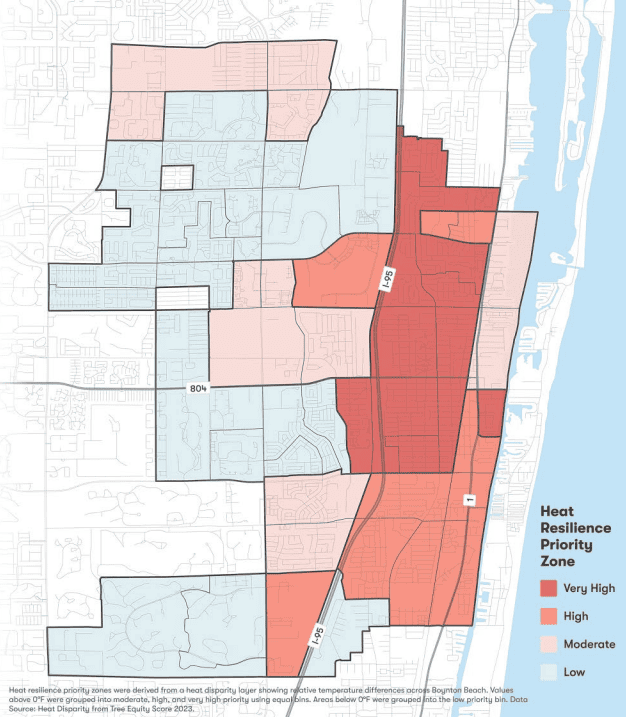
American Forests used 2022 surface temperature data to group Boynton Beach’s neighborhoods into four tiers of Heat Resilience Priority Zones. The different tiers describe, on average, how much hotter or cooler that neighborhood was in comparison to the 2022 heat extremity average for the broader Southeastern Florida urban area: Low (-7 to 0°F), Moderate (0 to +3°F), High (+3 to +6°F), and Very High (+6 to +10°F).
Using heat and tree canopy data, American Forests worked with the City to develop a feasible tree planting plan and a baseline citywide target of 15% canopy cover by 2035. To bridge the gap between planning and action, local non-profit partner Community Greening launched a tree drop-off program that delivered 168 trees directly to Boynton Beach residents.
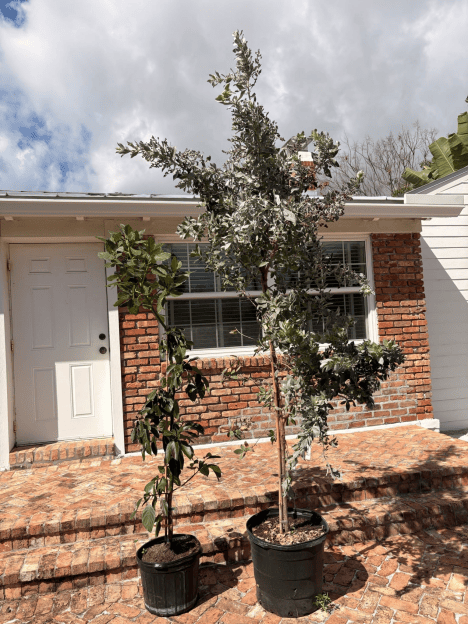
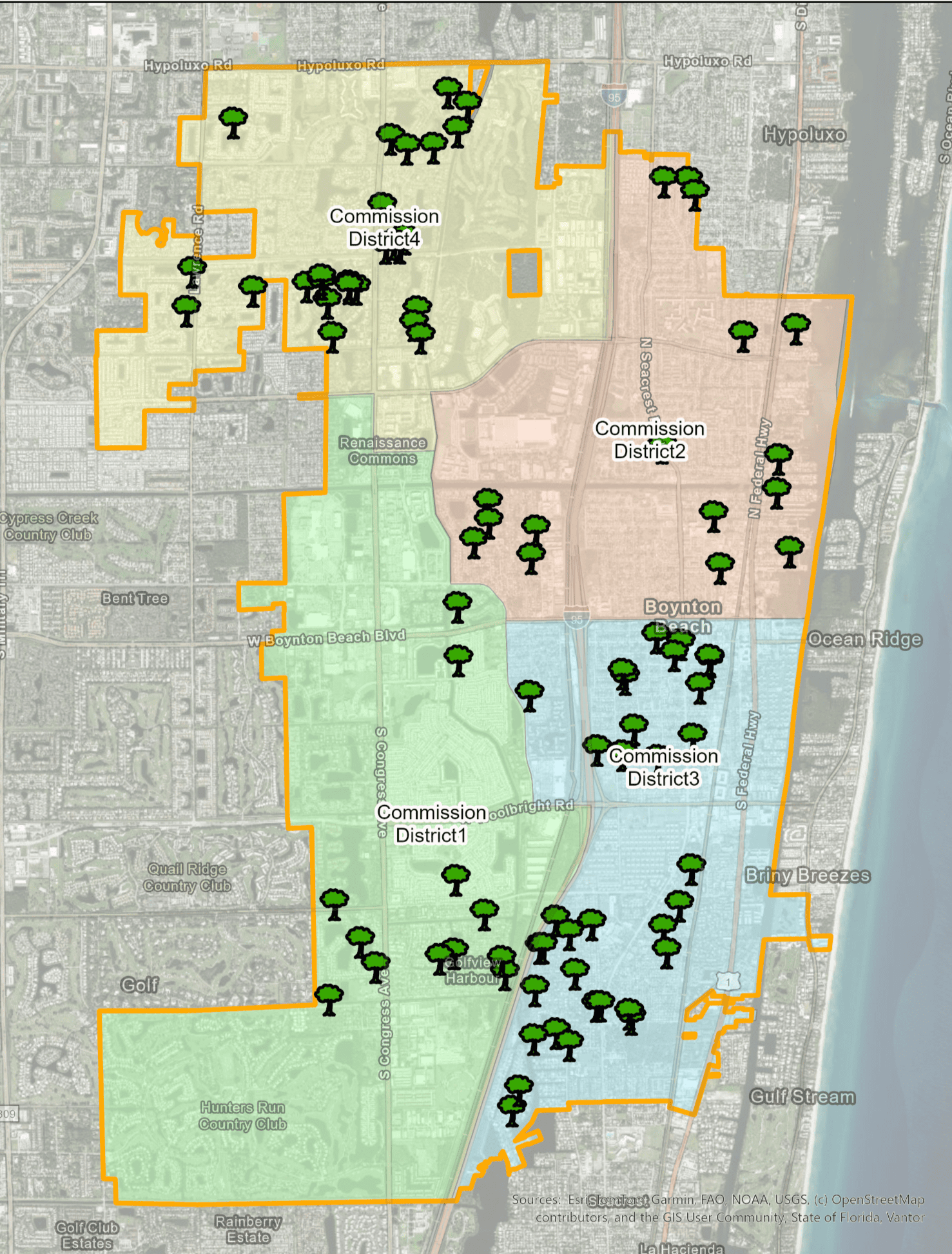
Community Greening dropped off 168 trees across the city, prioritizing residents who lived in the lowest tree-canopy areas (left). Residents who signed up could receive up to two trees, selecting either shade or fruit trees (right).
The final Resilient by Design document outlines 31 concrete actions spanning green infrastructure, nature-based solutions, municipal code updates, strategic partnerships, and community capacity building. Together, these strategies will help the City of Boynton Beach shift heat resilience from an ad hoc goal to a core municipal service.
“We’re grateful for the opportunity this grant made possible and for the efforts of the project team. Resilient by Design is the first heat resilience effort of its kind in Boynton Beach, and it gives us the tools to put community-focused solutions in place: expanding tree canopy, cooling our neighborhoods, and protecting the residents most at risk.”
Alannah Irwin, Administrator of Sustainability and Resiliency, City of Boynton Beach
To read the full strategy, visit the Boynton Beach Heat Resilience webpage.