Local governments continue to lead on climate action. Across the country, cities, counties, and towns are cutting community-wide greenhouse gas emissions, accelerating the deployment of renewable energy, and advancing mitigation and adaptation strategies tailored to local conditions. Yet these efforts often unfold within complex state legal frameworks, and in some instances, state preemption can constrain local authority.
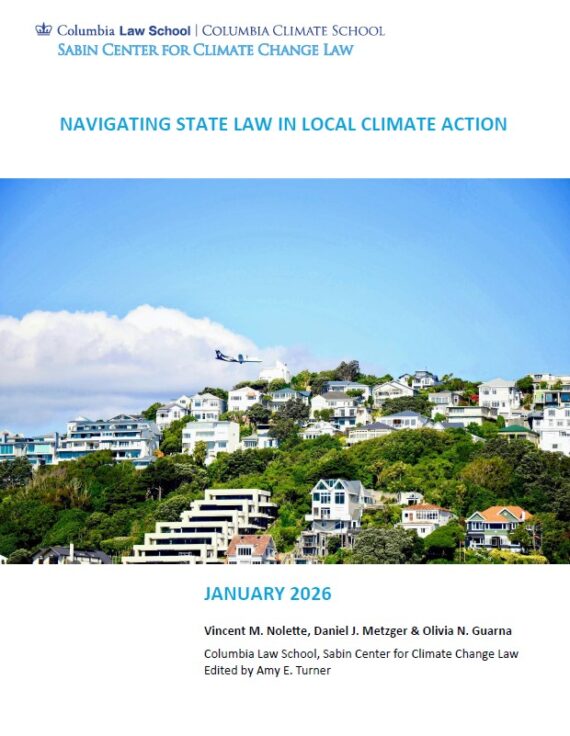
The Sabin Center for Climate Change Law’s Cities Climate Law Initiative released Navigating State Law in Local Climate Action, a new report that examines how nineteen states approach key state–local preemption issues affecting climate policy. The report provides state-specific legal analysis, identifies areas of constraint and opportunity, and highlights considerations relevant to local policymakers and practitioners.
Alongside the report, they are launching a series of online State Toolkits. These toolkits compile and synthesize essential legal authorities, case law, and practical resources for each of the nineteen states covered. Together, the report and toolkits are designed to serve as a foundational reference on state preemption and local climate authority, with a particular focus on how legal structures shape climate mitigation and adaptation efforts at the local level.